
Ekin and the Ekin-Gura Museum: Kochi’s Most Unique Cultural Art
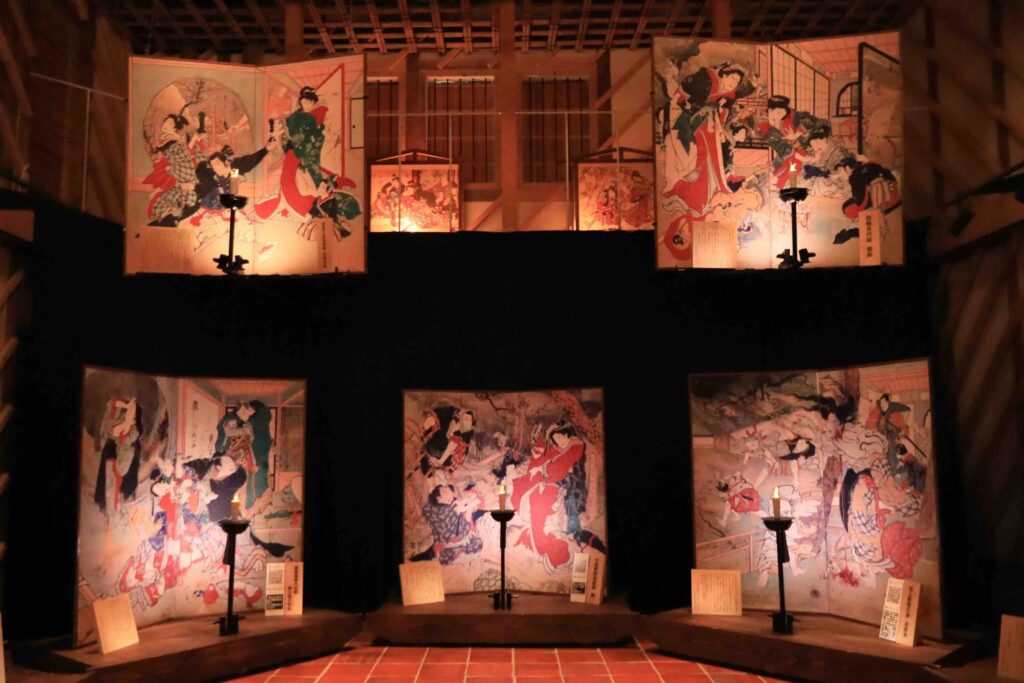
Somewhere between fine art and something much darker and more visceral, the paintings of Ekin occupy a world entirely their own. Bold, dramatic, and sometimes unsettling, these large folding-screen paintings were created by a 19th-century artist in a small coastal town in Kochi — and today they are preserved in a remarkable small museum that may be unlike anything you have ever visited before.
If you are arriving in Kochi by cruise ship and looking for a cultural experience that goes beyond temples and castles, the Ekin-Gura museum in Akioka Town is exactly that kind of discovery.
Who Was Ekin?
Ekin — whose real name was Hirose Kinzo — was born in 1812 in Akioka, a small post town along the old coastal road in what is now Kochi Prefecture. As a young man, he traveled to Osaka and trained under a master of the Kano school of painting, one of the most prestigious traditions in Japanese art.
By all accounts, he was talented enough to have had a successful career in the mainstream art world. But according to local legend, he was forced to return to his hometown after being involved in a counterfeiting scandal — he was reportedly so skilled at painting that he was able to reproduce paper currency convincingly enough to cause trouble.
Back in Akioka, Ekin channeled his extraordinary skill into a different kind of work: large folding-screen paintings depicting scenes from kabuki theater. These were not gallery pieces or paintings for wealthy patrons. They were created to be displayed outdoors during the summer Tosa Festival, hung from the fronts of shops and homes at night, lit by candlelight, and viewed by the local community as a form of popular entertainment.
Paintings Made for Candlelight
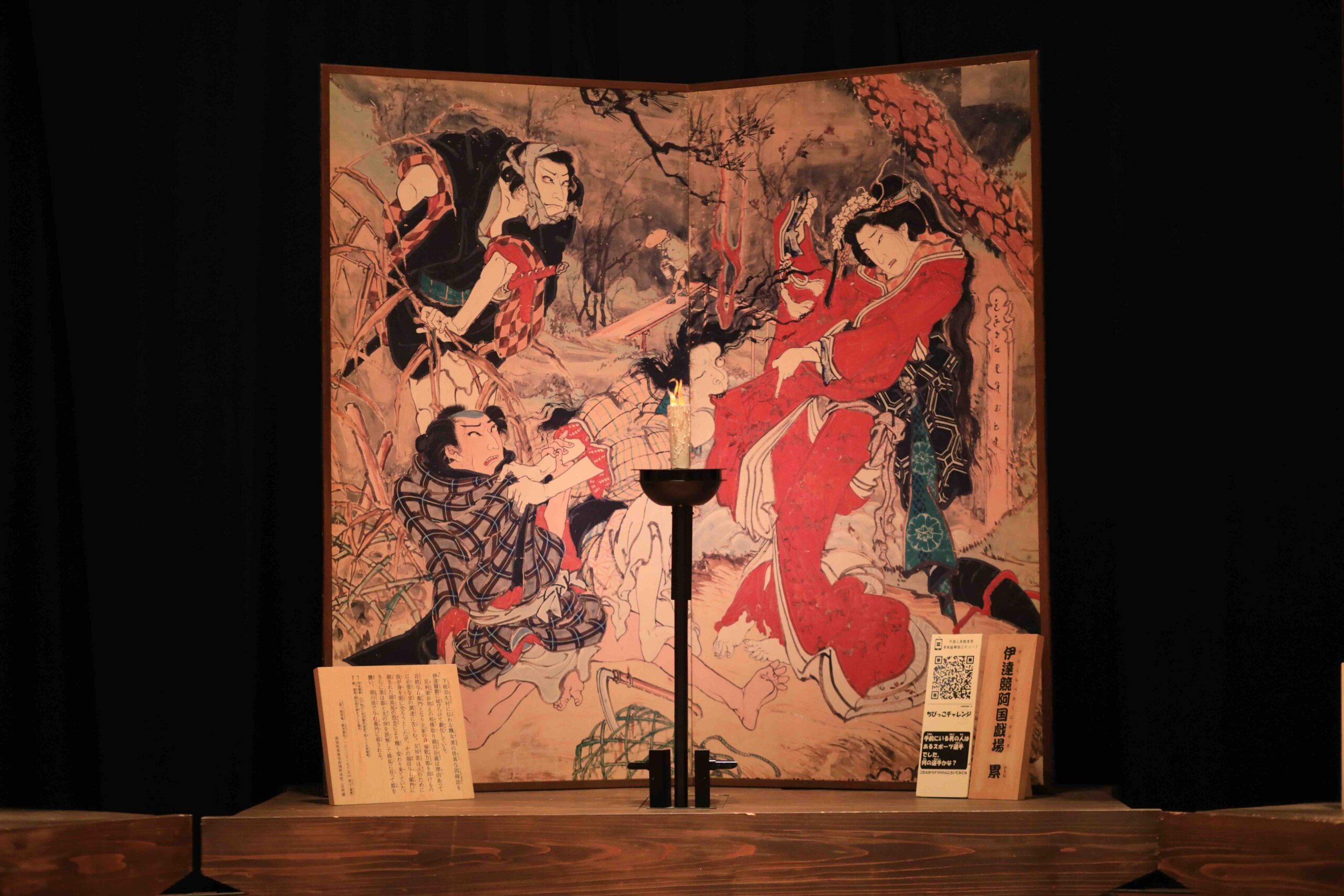
This is the key to understanding Ekin’s work, and it is also what makes the Ekin-Gura museum so distinctive as a viewing experience. These paintings were designed to be seen in flickering candlelight, not in daylight or under electric lamps. The contrast between bright reds and blacks, the dramatic expressions of the figures, the sense of movement and violence and passion — all of these qualities were calibrated for the specific conditions of a summer night festival, where the paintings would glow in the dark and draw crowds of excited viewers.
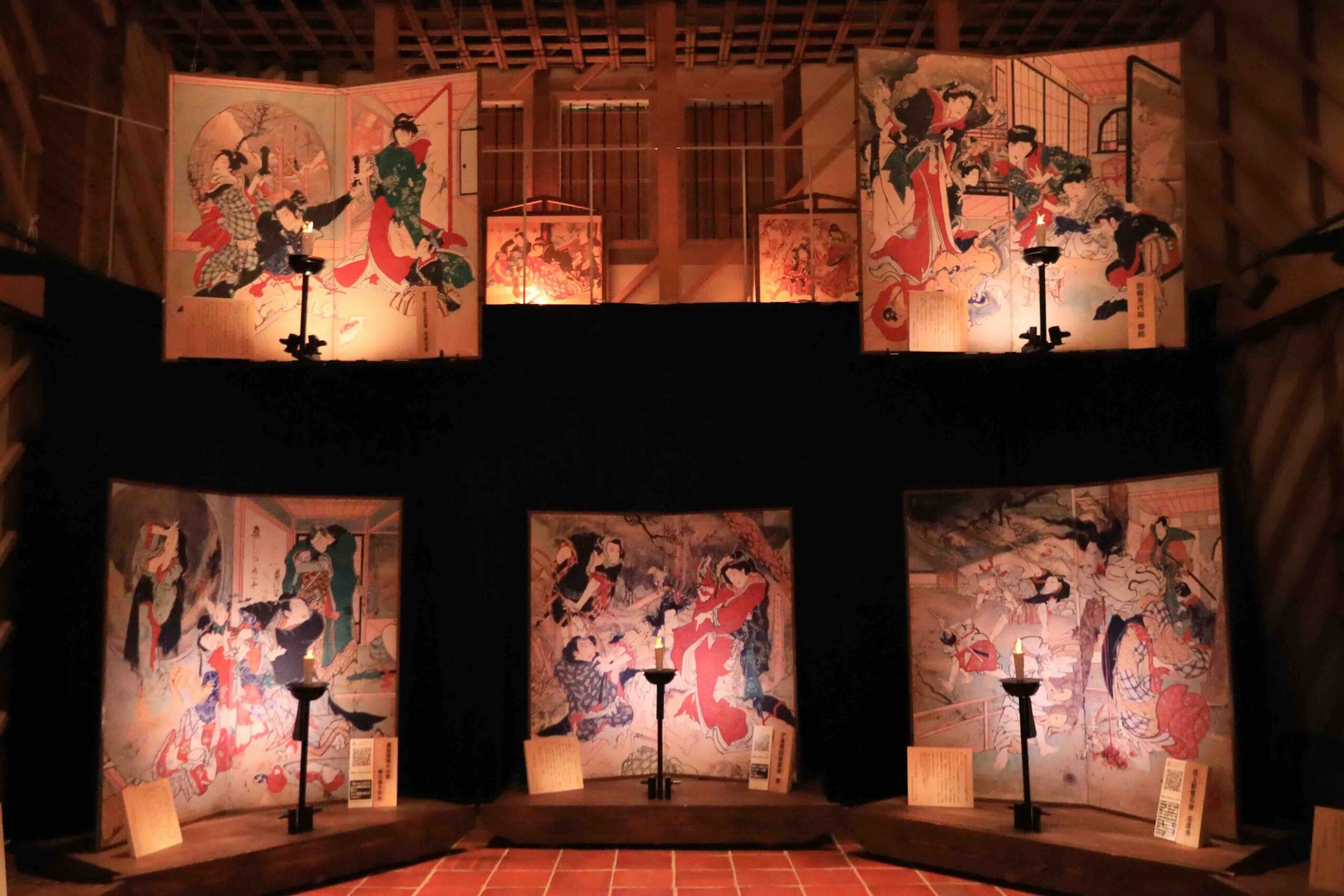
At the Ekin-Gura, the museum honors this original context by displaying the folding screens in a darkened interior, illuminated only by candle-style lighting. The effect is genuinely striking. The paintings seem to come alive in a way that they simply do not under normal lighting conditions.
What You Will See Inside
The museum is built around a collection of surviving Ekin folding screens, most of which depict famous scenes from kabuki plays. The characters are rendered with extraordinary energy — their faces caught in extreme expressions of rage, grief, terror, or defiance. The color palette is bold and high-contrast, dominated by deep reds, blacks, and whites. Battle scenes, supernatural encounters, moments of betrayal and sacrifice — Ekin painted all of them with the same fearless intensity.
Alongside the large folding screens, the museum also displays ink-brush works showing kabuki actors in characteristic poses. These black-and-white pieces, displayed along the corridors of the museum, show a completely different side of Ekin’s skill — precise, economical lines that capture personality and movement with remarkable economy.
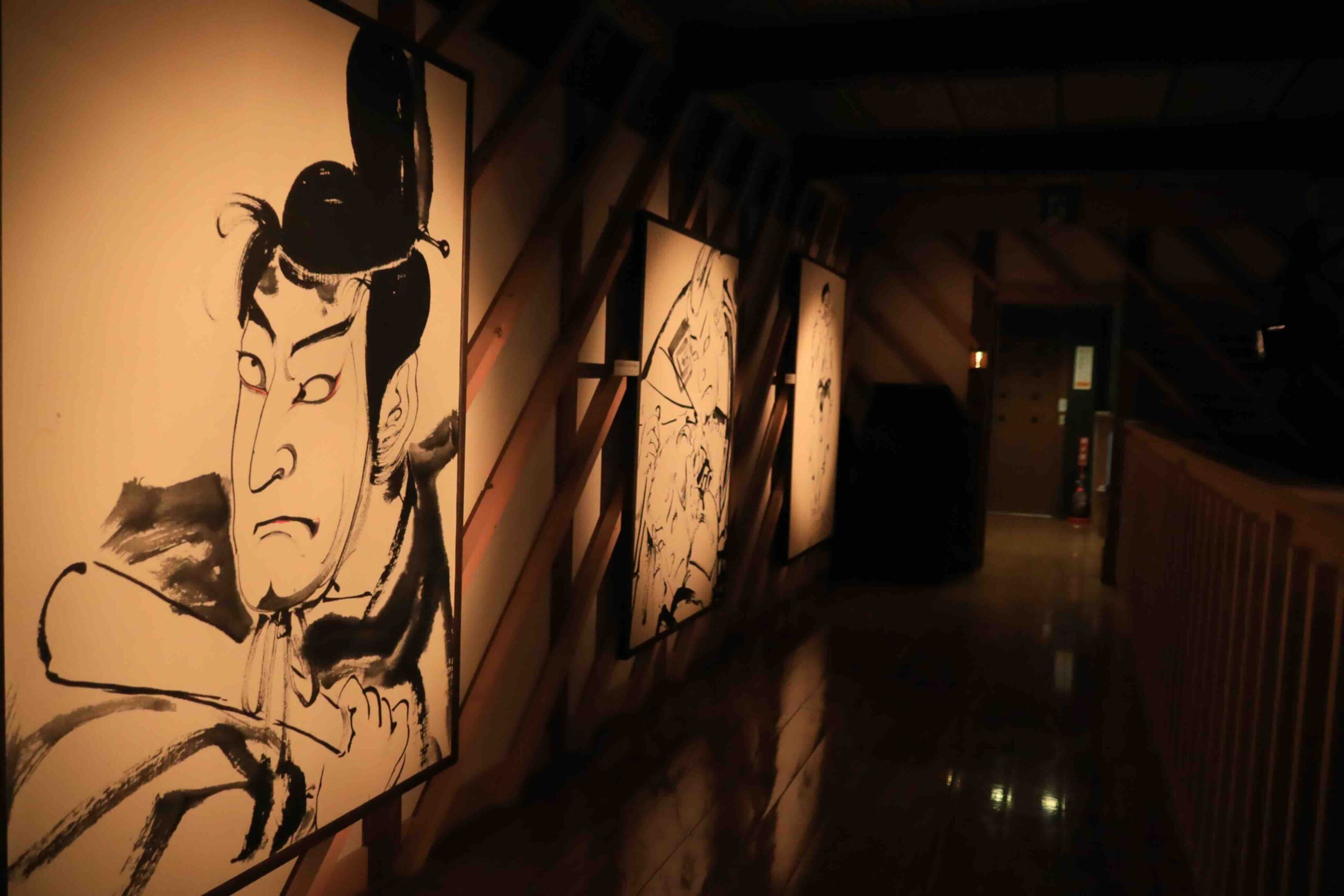
One of the things that guests consistently find surprising is just how modern Ekin’s work feels. Despite being painted in the mid-19th century, the compositions, the energy, and the emotional directness of these paintings feel closer to contemporary graphic art or manga than to what most people expect from traditional Japanese painting. It is an unexpected connection, and it makes the work immediately accessible to visitors from any cultural background.
The Ekin Festival: Paintings in Their Original Setting
If you are lucky enough to visit Kochi in mid-July, you may be able to experience the Akioka Tosa Festival, during which reproductions and some originals of Ekin’s folding screens are hung outside along the main street of the old post town, exactly as they were in Ekin’s own time. Viewed by candlelight on a summer night, surrounded by festival music and the smell of the season, it is one of the most unusual and memorable cultural events in all of Shikoku.
Even outside of festival season, the Ekin-Gura museum offers a rich and genuinely different cultural experience — one that most international visitors to Japan never encounter, simply because Akioka Town is not on the standard tourist route.
Getting There from Kochi Cruise Port
The Ekin-Gura is located in Akioka Town in Konan City, roughly 30 to 40 minutes by car from the Kochi cruise terminal. It pairs naturally with a visit to the Aki City samurai district or the Iwasaki Yataro birthplace, making it an ideal component of a full-day private shore excursion exploring the eastern part of Kochi Prefecture.
Perfect for Cruise Ship Passengers
Arriving in Kochi by cruise ship? The Ekin-Gura is one of those off-the-beaten-path experiences that private tour guests always remember. We will take care of all the logistics — pick-up from the Kochi cruise terminal, transportation, and a guaranteed return to the port on time.
Flexible timing options:
- ⏰ 4-hour express tour (perfect for short port calls)
- ⏰ 6-hour highlights tour (our most popular option)
- ⏰ 8-hour comprehensive experience
All tours include comfortable private transportation and a guarantee to return you to the port on time.
Experience Kochi’s Hidden Culture on Our Highlights Tour
The Ekin-Gura can be combined with Kochi Castle, the Aki City samurai district, the Iwasaki Yataro birthplace, or other highlights to create a full-day private tour tailored to your interests.
- Private transportation from Kochi cruise port
- Expert English-speaking licensed guide
- Small group experience with no crowds
- Flexible itinerary based on your interests
- On-time return to ship guaranteed